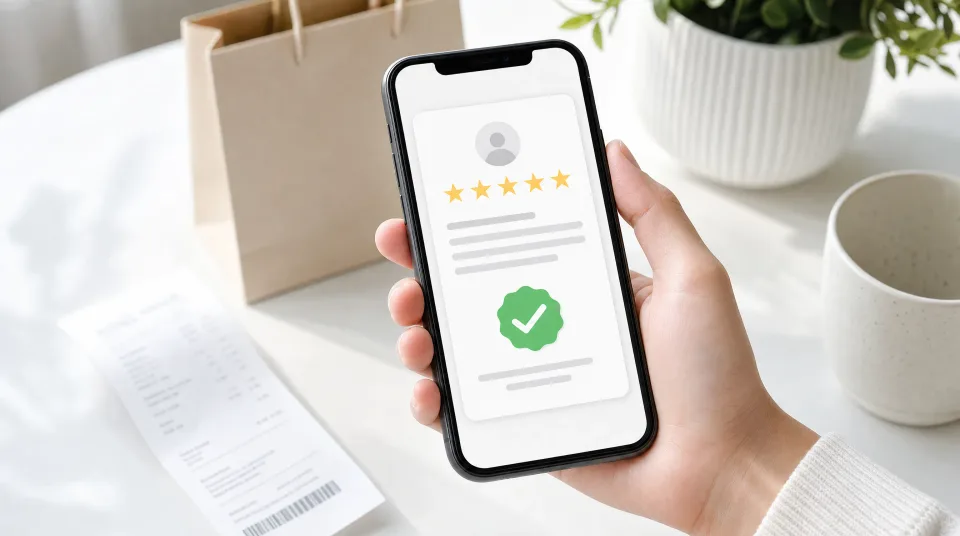
The short answer: Verified reviews are reviews for which the author's customer contact is documented – through an order number, a booking, an invitation sent after the purchase, or proof of a visit, for example. The label significantly reduces the risk of fake reviews. But it guarantees neither that every statement is true nor that every customer was equally likely to leave a review.
🧭 Navigation & terminology
Table of contents:
- What does "verified" mean for reviews?
- How do platforms check whether a review is genuine?
- What do verified reviews tell you – and what not?
- What does verification mean for companies?
- Conclusion
- FAQ
Key terms:
- Verified review: A review for which customer contact by the author is documented.
- Open platform: A portal where anyone with a user account can leave a review, with no proof of purchase or visit.
- Invitation-based review: The company or shop specifically invites customers to leave a review after a purchase.
- Proof of purchase: A record such as an order, booking, or reference number that links a review to a genuine business transaction.
Picture two guest books. The first lies open at the entrance of a holiday resort, and every passer-by can write in it. The second is handed only to guests who show their room key at reception. Both contain honest entries. But only with the second do you know that the writer really stayed there.
That is exactly the difference the word "verified" marks. By now it turns up on many portals – sometimes as a check mark, sometimes as "Verified purchase", sometimes as "Checked review". What lies behind it, however, differs considerably.
What does "verified" mean for reviews?
What is a verified review?
A verified review is a customer opinion for which it has been documented, before or after publication, that genuine customer contact took place. At its core it is about who is writing – not what they write. One essential feature is the link to a verifiable transaction such as an order or a booking, which largely rules out reviews from people who were never involved.
The term is not just marketing. Since 2022 it has had a legal side as well. Under § 5b (3) of the German Act Against Unfair Competition (UWG), companies that make consumer reviews accessible have to state whether and how they ensure that those reviews come from genuine buyers or users. And under the Annex to the UWG (No. 23b), it is always unlawful to claim that reviews come from genuine buyers or users when no reasonable and proportionate steps have been taken to check that.
An important distinction follows from this: many reviews are genuine without being verified. Verification is proof of authenticity, not a precondition for it. Our guide on the difference between a rating and a review explains how stars and text complement each other.
How do platforms check whether a review is genuine?
Broadly speaking, five procedures can be distinguished. They range from a hard link to the purchase through to a check that happens only in the event of a dispute.
Linked to the order. Trusted Shops states that it only lets reviews appear in its system if they carry a unique reference number. Only someone who has ordered from the shop in question can leave a review, usually by invitation. Trusted Shops also checks reviews automatically and manually.
Linked to the booking. At Booking.com, the only route to a review is a prior booking. The platform emphasizes that the reviewers are genuine guests of the property.
Partial verification. On Trustpilot, it is above all the reviews a company invited after a purchase that count as verified. Alongside those, organic reviews without proof of purchase are possible there as well. At Amazon, reviews receive the "Verified Purchase" label when the product was bought through Amazon – unverified reviews still exist.
Proof of visit. At reviewfinder, every review submitted directly there requires proof that the user was actually on site – a photo of the visit, for example. Reviews that reviewfinder bundles from other portals are marked with their source.
Open system with moderation. At Google you have to be signed in, anonymous reviews are not possible, and Google moderates the content. For a review, however, Google does not require proof of a purchase or a visit. You can read more about the specifics on our page on Google reviews.
| Procedure | Example | What is checked | When it is checked |
|---|---|---|---|
| Linked to order | Trusted Shops | Reference/order number | Before the review |
| Linked to booking | Booking.com | Completed booking | Before the review |
| Partial verification | Trustpilot, Amazon | Invitation by the company, or purchase through Amazon | Before the review – for only some of the reviews |
| Proof of visit | reviewfinder | Visit (e.g. photo) | Before the review |
| Open system | User account and moderation, no customer proof | Ongoing, automated before and after publication |
What do verified reviews tell you – and what not?
Verification measurably changes how reviews turn out and how they are perceived. In 2017, the Spiegel Research Center at Northwestern University found that verified buyers are more likely to award four or five stars than anonymous reviewers. Anonymous authors, by contrast, awarded one or two stars far more often. At the same time, a verification badge increased purchase likelihood by 15%.
The finding is revealing in two ways. It shows that readers trust the label. And it raises the question of where the difference comes from. One possible explanation: without a check, non-customers can leave reviews too. It is equally conceivable that invited buyers generally judge more moderately than people who write of their own accord.
❌ Myth: "A verified review is automatically true."
✔ Fact: Verification documents the customer contact, not the content. A genuine customer can exaggerate, be mistaken, or judge unfairly. The usual rules apply to the content: opinions are permitted, false statements of fact are not.
A second limit is more subtle. In invitation-based systems, the company decides whom it invites and when. If a shop systematically invites only certain customers, a distorted picture emerges – even though every single review is verified. So look beyond the label and watch for patterns: the distribution of stars, the timing, the level of detail. Our guide on how to spot fake reviews shows the typical warning signs.
💬 Expert view: "A check mark answers the question 'Was this person really there?'. The question 'Does the overall picture add up?' is only answered by several independent sources." – Lars Hermes
What does verification mean for companies?
For companies the topic has two sides: an obligation and a lever.
The obligation applies to everyone who shows customer reviews on their own website, in their shop, or in advertising. Under § 5b (3) UWG they have to state whether and how they check authenticity. Anyone who does not check is allowed to say so openly – they just must not create the impression that checks are being carried out. Anyone who actually buys reviews is on forbidden ground in any case, as our guide Is it legal to buy reviews? shows.
The lever comes into play in a dispute. If a company disputes that the author of a negative review was ever a customer, the platform has to look into it. In 2022 the Bundesgerichtshof, Germany's Federal Court of Justice, ruled (case no. VI ZR 1244/20) that a holiday park's objection – that the review was not based on any guest contact – is in principle sufficient, provided the author's identity is not readily apparent from the review itself. If the portal does not investigate, the absence of contact is taken to be true and the review is unlawful. Verification is therefore demanded here after the fact. Our guide on getting a Google review removed describes how to use this approach in practice.
Conclusion: Verification answers the "who", not the "what"
Verified reviews are a strong trust signal because they largely shut out people who were never involved. But the label is no seal of quality for the content. How much it is worth depends on the procedure: a review tied to an order number is a different thing from a check mark that only invited customers receive.
For readers that means: with every check mark, ask how the check was done, and compare several sources. For companies it means: disclose your verification procedure and rely on platforms that document genuine customer contact. If you want to show your reviews from several portals bundled together and traceable to their source, you can register your company with reviewfinder.
Frequently asked questions
What does "Verified Purchase" mean on Amazon?
The label shows that the author bought the product through Amazon. Reviews without this label are possible too – for instance when the product was bought elsewhere. They are not automatically false, but as far as Amazon is concerned the purchase is not documented.
Are Google reviews verified?
No, not in the sense of a proof of purchase. A Google review requires a Google account, anonymous reviews are not possible, and Google moderates the content. But Google does not require any proof of a purchase or a visit.
Are verified reviews always genuine?
They are tied to a verifiable customer transaction, but they are not automatically accurate. A genuine customer can exaggerate or be mistaken. On top of that, in invitation-based systems a company can influence who gets invited. Verification therefore reduces fakes, but it does not replace a critical eye.
As a company, do I have to state whether my reviews are checked?
Yes, if you make consumer reviews accessible. Under § 5b (3) UWG, information about whether and how you ensure authenticity counts as material. If it is missing, that can be judged to be misleading by omission.