
The short answer: Yes, but only in certain cases. You can be sued for a bad review if it asserts false or unprovable facts, is insulting, or is only meant to disparage. Honest opinions such as "unfriendly service" or "disappointing for the price" are protected by freedom of expression – even when they are harsh. Where a review is impermissible, what usually follows is a cease-and-desist letter with a demand to stop, and only rarely criminal proceedings.
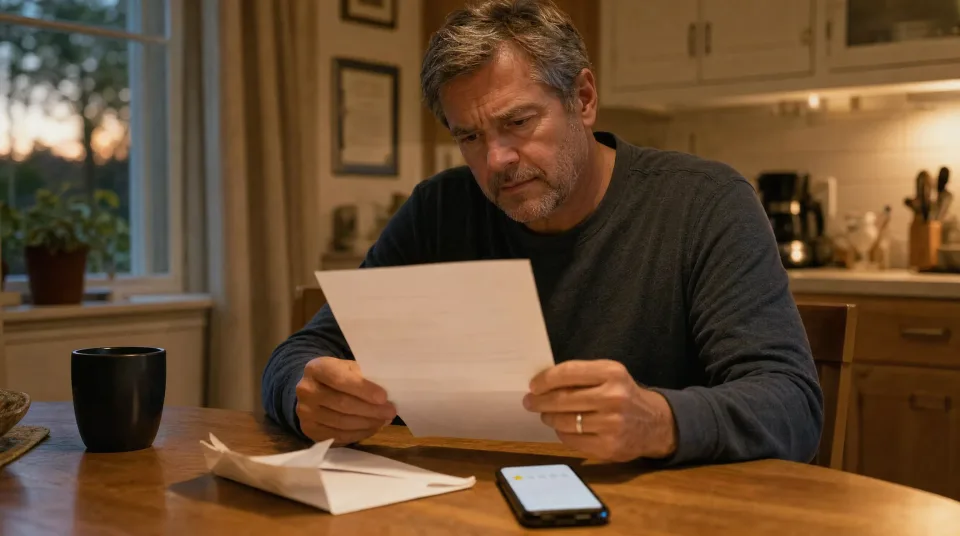
A letter from a lawyer, a few days after a one-star review: for many consumers that comes as a shock. Suddenly there is talk of a cease-and-desist declaration, the amount in dispute and deadlines. And all you wanted was to warn others about a bad experience.
The worry is understandable, but often unfounded. Case law protects critical reviews to a large extent. The line runs at a point that is easy to learn: between what you think and what you assert as fact.
Where does the line between opinion and fact run?
This distinction is the key to almost every dispute about reviews.
What is an expression of opinion?
An expression of opinion is a value judgment shaped by a position taken and a personal view. It cannot be proven true or false. Sentences like "The advice was superficial" or "I found the food bland" are opinions. They are protected by Art. 5 Abs. 1 GG (the German Basic Law).
What is a statement of fact?
A statement of fact describes an event that can be verified. "The technician arrived two hours late" or "My wardrobe was damaged during the move" are facts. They are permitted if they are true. Untrue statements of fact, by contrast, do not fall under freedom of expression from the outset.
That is exactly how the Landgericht Frankenthal (LG Frankenthal, Frankenthal Regional Court, judgment of 22 May 2023, case no. 6 O 18/23) put it. A customer had given a removal company one star and claimed that a piece of furniture had been damaged and not repaired. The court classified that as a statement of fact. Because the customer could not prove the damage, he had to stop making the statement. The amount in dispute was 10,000 euros. Another sentence in the same review – that something was damaging to credibility "in my view" – remained permissible as an opinion.
| Wording | Classification | Risk |
|---|---|---|
| "I was dissatisfied with the advice." | Opinion | Very low |
| "For this price I would have expected more." | Opinion | Very low |
| "The tradesperson arrived two hours late." | Fact – permissible if provable | Low where you have evidence |
| "My parcel was never delivered." | Fact – has to be true | High if false |
| "They systematically defraud their customers." | Factual core, hard to prove | High |
| Abuse or personal disparagement | Insult or abusive criticism | Very high |
Which rulings have protected critical reviews?
Courts often allow criticism to go remarkably far. In 2009, the Landgericht Hannover (LG Hannover, Hannover Regional Court, case no. 6 O 102/08) held that the eBay comment "That's what I call fraud!!!!" was a permissible expression of opinion – but only because the buyer was at the same time describing a true set of facts: a phone offered as new was used. The Landgericht Augsburg (LG Augsburg, Augsburg Regional Court, case no. 034 O 275/16) dismissed a company's claim against a Google review that dismissed its offering as "pipe dreams". Criticism like that, the court held, is something a company has to put up with. And according to the Landgericht München I (LG München I, Munich I Regional Court, case no. 25 O 6581/17), doctors too have to tolerate negative value judgments on Jameda.
The difference from the Frankenthal case is clear: there, the issue was a specific, verifiable allegation that the customer could not substantiate. In the other cases, the reviews at issue recognizably expressed a stance.
❌ Myth: "A company can have any negative review banned if it damages its business."
✔ Fact: Damage to the business alone is not enough. Honest value judgments are protected, even when they cost revenue. A claim only arises where there are false or unprovable facts, insults, abusive criticism – or where there was no customer contact at all.
What consequences can an impermissible review have?
The most common consequence is a civil one: the company demands that you delete the statement and refrain from repeating it in future. Usually that happens by way of a cease-and-desist letter with a pre-drafted cease-and-desist declaration. Anyone who signs it and then breaches it again pays a contractual penalty. Anyone who refuses risks a lawsuit or an interim injunction – with court and lawyer's fees based on the amount in dispute.
Criminal consequences are possible, but rare. The offences that come into question under the German Criminal Code (StGB) are insult (Beleidigung, § 185 StGB), defamation (üble Nachrede, § 186 StGB) and intentional defamation (Verleumdung, § 187 StGB). Üble Nachrede can be punished with imprisonment of up to one year or a fine, and with up to two years if committed publicly. For Verleumdung, that is to say knowingly false assertions, it is up to two years, and up to five years if committed publicly. Online reviews are generally regarded as public in this context. As a rule, these offences are only prosecuted on a criminal complaint by the person affected (§ 194 StGB). Anyone who describes their own experience factually is a long way from all of that.
Can a company find out who wrote the review?
Not easily. The Bundesgerichtshof ruled in 2014 (case no. VI ZR 345/13) that a doctor could not demand a reviewer's name and address from the portal operator. Today, § 21 TDDDG governs the release of user data. It requires that content meets the elements of certain criminal offences such as insult, üble Nachrede or Verleumdung and thereby violates absolutely protected rights. In addition, a prior court order is necessary.
Important in practice: anyone who reviews under their real name, or mentions details that only one particular customer can know, is often identifiable to the company anyway. Anonymity is therefore no free pass – the rules for opinion and fact always apply.
What to do if you receive a cease-and-desist letter over a review?
- Stay calm and note the deadline: Cease-and-desist letters usually set short deadlines. Make a note of the date. ➔ Result: you miss no deadline.
- Sign nothing unchecked: Pre-drafted cease-and-desist declarations are often drawn more widely than necessary. ➔ Result: you do not tie yourself to a contractual penalty prematurely.
- Classify the sentences objected to: Is it opinion or fact? Can you substantiate the fact, for instance with photos, invoices or emails? ➔ Result: a realistic assessment of your position.
- Get legal advice: A law firm specializing in media or expression law can check whether the demand is justified and, where appropriate, draft an amended declaration. Consumer advice centres often provide a first orientation. ➔ Result: a well-founded reply instead of a snap decision.
- Adjust the review if appropriate: Rewording an unsubstantiated fact as a personal impression, or deleting it, lowers the risk of future disputes. Careful: where you have already received a cease-and-desist letter, that usually does not dispose of the claim for injunctive relief – whether an (amended) cease-and-desist declaration is additionally necessary is something a lawyer should check. ➔ Result: your criticism stays visible and the legal exposure gets smaller.
How do you write a critical review on safe legal ground?
The best safeguard is a review that is honest, specific and fair. Describe what you experienced yourself, flag your assessments as your personal view, and stick to facts you can substantiate. Avoid guesses about motives and avoid disparaging terms. You will find detailed phrasing help in our guide on writing a good review, and the basics of structure in the article on the difference between a rating and a review.
💬 Expert view: "The sharpest criticism is often the most sober. If you describe precisely what happened, you need no strong language – and you stand on far safer legal ground." – Lars Hermes
The same principles apply to employer reviews. Our guide on getting a Kununu review removed shows how companies can take action against reviews there. And if you would like to leave a review on Trustpilot, the instructions on leaving a Trustpilot review will help.
Conclusion: honesty is the best legal protection
Being sued for a bad review is possible, but it is tied to clear requirements. Anyone who describes their own experience and phrases opinions as opinions is well protected by freedom of expression – even with harsh criticism. It becomes risky with facts you cannot prove, and with insults.
So before you submit, test every sentence with one simple question: could I substantiate this if someone asked? If not, phrase it as your personal impression. That way your review stays helpful for others – and safe for you.
Frequently asked questions
Can you be reported to the police for a negative Google review?
A criminal complaint is theoretically possible, for instance for insult, üble Nachrede or Verleumdung. With factual criticism of your own experience, however, it has little prospect of success. More common is the civil route via a cease-and-desist letter with a demand to stop.
Is "rip-off" (Abzocke) allowed in a review?
That depends on the context. As a pointed opinion about value for money, a term like that can be permissible – the LG Hannover held "That's what I call fraud!!!!" to be permissible because the buyer was at the same time describing a true set of facts. But if the review imputes specific criminal acts that you cannot substantiate, it becomes risky.
Do I have to prove that I was a customer?
If the company disputes the customer contact, the platform will generally ask for evidence. If you cannot supply any, the review is usually deleted. So keep your invoices, booking confirmations or emails.
Do I have to sign a cease-and-desist declaration?
Not unchecked. Pre-drafted declarations often go beyond what can legally be demanded. Have the demand checked by a law firm. If it is partly justified, an amended declaration can make sense.